
Perspective Analysis & Perspective Analytics: AI, Data and Better Marketing Decisions
UPDATED: 09/09/2026 | AI Lean Marketing / Pv
What Is Perspective Analysis?
Perspective analysis is the process of examining information, data, problems and opportunities from multiple viewpoints to develop a more complete understanding before making a decision.
In marketing, perspective analysis means looking beyond an individual metric, channel or dataset. It combines quantitative data, customer behavior, business context, market conditions, experimentation, artificial intelligence and human judgment to understand not only what happened, but why it may have happened, what else could explain it and what should happen next.
This distinction is increasingly important in an AI-driven marketing environment.
Marketers now have access to enormous amounts of data and increasingly powerful artificial intelligence capable of finding patterns, analyzing customer behavior, summarizing information and generating recommendations. But more analysis does not automatically produce better decisions.
Data provides signals. AI expands our ability to analyze those signals. Perspective helps determine what those signals actually mean for the business.
What Is Perspective Analytics?
Perspective Analytics is RWO Marketing’s framework for applying perspective analysis to marketing data, experimentation, decision-making and growth.
RWO originally introduced the Perspective Analytics framework in 2019 as an alternative to marketing analytics focused primarily on monitoring data and producing linear interpretations of what had already happened.
The framework asks marketers to continually move from information toward action:
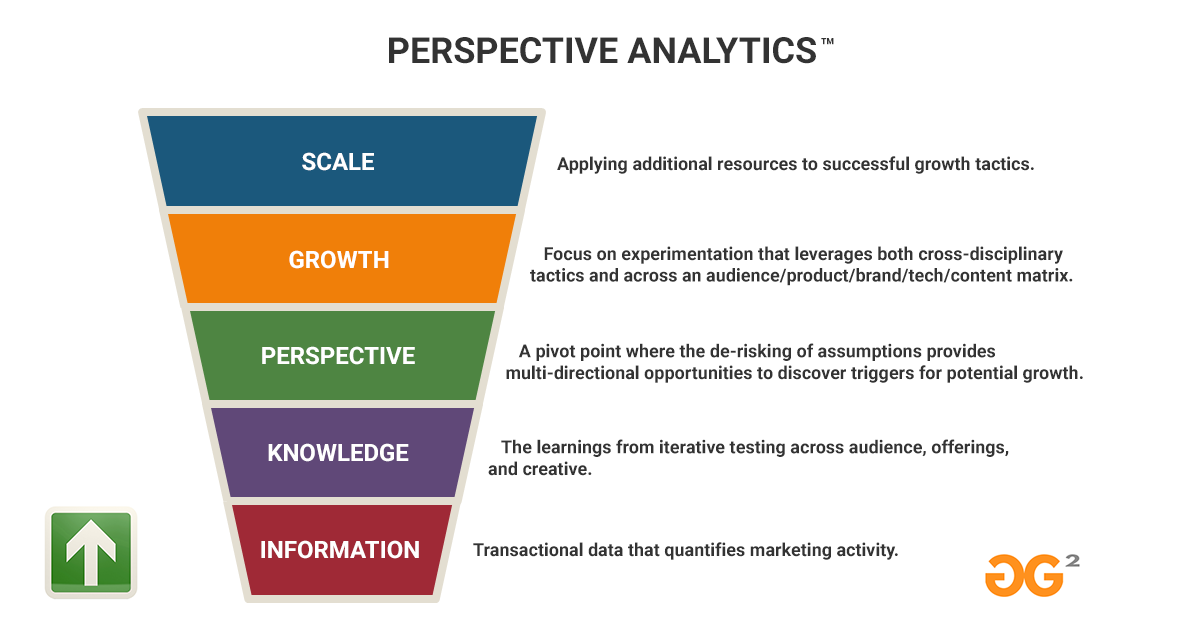
Information → Knowledge → Perspective → Growth → Scale
The arrival of modern artificial intelligence makes that framework even more relevant.
AI can dramatically accelerate the Information and Knowledge stages. It can process datasets, recognize patterns, compare audiences, analyze language, identify anomalies and generate possible explanations at a speed and scale that were previously impossible.
But AI does not eliminate the need for perspective.
It increases it.
Perspective Analysis vs. Perspective Analytics
The terms are closely related but useful to distinguish.
Perspective analysis is the broader process of examining an issue from multiple viewpoints, sources of information and possible explanations before reaching a conclusion.
Perspective Analytics is RWO Marketing’s structured methodology for applying that principle to marketing and growth.
In practical terms, perspective analysis is something a marketer does. Perspective Analytics provides a framework for repeatedly applying that thinking to information, testing, growth and scale.
The relationship can be summarized simply:
Perspective Analysis = examine the problem from multiple angles.
Perspective Analytics = turn those perspectives into a repeatable system for learning and growth.
Why Perspective Analysis Matters More in the Age of AI
Artificial intelligence has dramatically reduced the time required to analyze information.
AI can help marketers analyze advertising performance, website behavior, CRM data, customer feedback, search activity, sales conversations, competitive information and content performance. It can find relationships between information that might otherwise take a human analyst hours or days to discover.
That creates enormous opportunity, but it creates another problem:
AI can generate more answers than organizations can effectively evaluate.
An AI-generated explanation may be plausible without being correct. A pattern can be statistically interesting without being strategically important. A recommendation can make sense when viewed through one dataset while becoming much less compelling when customer behavior, economics or business constraints are considered.
Perspective analysis provides a way to challenge those conclusions.
Instead of asking only:
“What does the data say?”
we can ask:
- What does the data appear to tell us?
- What other explanations could produce the same result?
- What does the customer perspective tell us?
- What does the sales perspective tell us?
- What has changed in the market?
- What assumptions are we making?
- What might the AI be missing?
- How could we test our interpretation?
- What would make us change our conclusion?
That is where perspective turns analysis into strategy.
How Does AI Fit Into Perspective Analysis?
AI functions as an intelligence layer within perspective analysis rather than as a replacement for human decision-making.
Depending on the available data and systems, AI can help marketers:
- Analyze large volumes of structured and unstructured data
- Identify patterns and anomalies
- Compare customer and audience segments
- Summarize customer feedback and sales conversations
- Identify recurring customer questions and concerns
- Analyze search and content behavior
- Find relationships across marketing channels
- Generate alternative explanations for performance changes
- Develop hypotheses for testing
- Model possible scenarios
- Surface information that deserves deeper human investigation
The value of AI is not simply that it produces an answer faster.
Its greater value may be its ability to expose marketers to more possible perspectives before they make a decision.
Why Human Perspective Still Matters
AI can analyze information at a scale humans cannot, but marketing decisions exist inside a business and customer context.
Human marketers contribute information and judgment that may not exist cleanly inside a dataset:
- Business objectives
- Brand positioning
- Customer relationships
- Organizational constraints
- Competitive nuance
- Product knowledge
- Ethics and reputation
- Creative judgment
- Strategic priorities
- Acceptable levels of risk
A marketing recommendation that optimizes a metric while damaging customer trust is not a good recommendation.
A campaign that generates more leads but produces substantially worse customers is not necessarily an improvement.
A content strategy that generates enormous AI-driven output without creating customer value is not automatically a content strategy worth scaling.
AI expands what marketers can see. Human perspective helps determine what matters.
The Five Stages of Perspective Analytics
RWO’s Perspective Analytics framework organizes the process into five connected stages:
Information → Knowledge → Perspective → Growth → Scale
1. Information
Information is the raw material of marketing analysis.
It can include website analytics, search data, advertising performance, conversions, CRM activity, customer behavior, sales information, email engagement, content performance, customer feedback, reviews, social signals and other first-party or third-party information.
Historically, one of the primary marketing challenges was collecting enough usable information.
Today, many organizations face the opposite problem.
They have more information than they can meaningfully interpret.
AI can help organize, classify, summarize and connect that information, allowing marketers to move faster from raw data toward useful knowledge.
2. Knowledge
Information becomes knowledge when patterns, relationships and lessons begin to emerge.
For example:
- One audience consistently converts at a higher rate than another.
- An offer generates large numbers of leads but relatively few customers.
- A group of articles attracts visitors who later become qualified leads.
- One message consistently outperforms another.
- Customer conversations reveal a buying motivation missing from the current marketing.
- A campaign works well in one channel but poorly in another.
AI can accelerate this process by analyzing information across datasets and customer interactions.
But knowledge should not automatically be confused with truth.
A pattern is something to investigate. An AI-generated insight is something to evaluate. A hypothesis becomes useful when we can test it.
3. Perspective
Perspective is the pivotal stage of the framework.
This is where data, AI-generated insights, customer understanding, experimentation, market conditions and business objectives are considered together.
The goal is to understand why something may be happening and identify alternative explanations.
Imagine that a landing page’s conversion rate suddenly declines.
A conventional analysis might conclude that the landing page needs improvement.
Perspective analysis asks what else could have changed:
- Did traffic quality change?
- Did advertising targeting expand?
- Did search intent change?
- Did a competitor introduce a new offer?
- Did pricing change?
- Did the traffic mix shift toward mobile?
- Did the customer journey change before visitors reached the page?
- Is there a technical problem?
- Is the conversion decline actually concentrated within one audience?
Each perspective creates another possible explanation.
The objective is not endless analysis. It is to identify the explanations most worth testing.
4. Growth
Perspective creates hypotheses. Growth comes from testing them.
Those experiments can occur across a broad marketing matrix:
- Audience
- Product
- Offer
- Positioning
- Pricing
- Brand
- Creative
- Content
- Search
- AI discovery
- Paid media
- Technology
- Conversion experience
- Lead nurturing
- Sales alignment
Perspective Analytics does not assume that growth will come from one dramatic breakthrough.
Growth often results from discovering a combination of incremental improvements across the customer journey.
Test. Measure. Learn. Keep what creates value. Discard what does not.
5. Scale
Once an approach demonstrates repeatable value, additional resources can be allocated to it.
That might mean increasing advertising spend, expanding into another market, producing more content around a successful subject, automating part of a customer journey, targeting additional audiences or extending a successful offer.
But scale is not the end of Perspective Analytics.
Scaling produces new information.
Markets change. Competitors respond. Customer behavior evolves. Search behavior changes. AI systems change how people discover information. Acquisition costs fluctuate.
That new information feeds back into the framework and begins another cycle.
How to Conduct a Perspective Analysis in Marketing
A marketing perspective analysis can begin with a relatively simple process.
Define the decision or problem
Start with a specific question. For example: Why did lead quality decline? Why is customer acquisition becoming more expensive? Why did organic traffic increase without a corresponding increase in sales?
Gather relevant information
Bring together the information that could help explain the issue. Avoid limiting the analysis to the channel where the symptom first appeared.
Identify multiple perspectives
Examine the problem through different lenses such as customer, audience, channel, product, offer, competitive, financial, technical, sales and market perspectives.
Use AI to expand the analysis
AI can help summarize information, identify patterns, find anomalies and generate alternative explanations that deserve investigation.
Challenge the initial conclusion
Ask what other factors could explain the same result. Look specifically for evidence that contradicts the most obvious interpretation.
Develop testable hypotheses
Convert the strongest explanations into hypotheses that can be validated through experiments or additional evidence.
Test and measure
Run the most useful experiments and measure the results against meaningful business outcomes.
Update your perspective
Use the results to change what you believe about the customer, market or marketing strategy.
The objective of perspective analysis isn’t to prove that the original idea was correct. It is to improve the quality of the next decision.
A Simple Perspective Analysis Example
Suppose a company sees a 25% increase in website traffic but no increase in qualified leads.
A traffic-focused analysis might celebrate the increase.
A conversion-focused analysis might conclude that the website is underperforming.
A perspective analysis considers several possibilities:
- Traffic perspective: Where did the additional visitors come from?
- Intent perspective: Were those visitors researching or actually considering a purchase?
- Audience perspective: Did the demographic or business profile of visitors change?
- Content perspective: Which pages generated the increase?
- Conversion perspective: Did conversion rates change for existing high-value traffic?
- Sales perspective: Did lead quality or close rates change?
- Customer perspective: Were visitors finding what they actually needed?
- Financial perspective: Did the additional traffic create meaningful economic value?
AI could help analyze these datasets and surface relationships between them.
The resulting perspective might reveal that traffic did not really become more valuable at all. Perhaps informational content began attracting a much larger research audience while high-intent traffic remained essentially unchanged.
That changes the decision.
The question is no longer simply, “How do we improve the conversion rate?” It may become, “How do we convert this newly acquired informational audience into future demand?”
Changing the perspective changes the strategy.
Perspective Analysis vs. Traditional Marketing Analytics
Traditional marketing analytics often begins with metrics: traffic, impressions, clicks, conversions, cost per acquisition, revenue and return on advertising spend.
Those measurements remain essential.
Perspective analysis adds another layer by examining the relationships, assumptions and context surrounding those metrics.
A dashboard might show that conversions declined 15%.
Perspective analysis asks:
Compared with what? For whom? From which traffic? Under what conditions? Why? What changed? What other explanation is possible? And what should we test?
The difference is not data versus intuition.
It is data viewed from one angle versus data examined through enough relevant perspectives to make a better decision.
Perspective Analysis vs. Predictive Analytics
Predictive analytics uses historical and current data to estimate what is likely to happen in the future.
Perspective analysis serves a different purpose.
It examines a problem or opportunity through multiple viewpoints and considers how context changes the interpretation of available information.
The two approaches can complement each other.
A predictive model might estimate that a customer has a high probability of converting. Perspective analysis can help marketers ask why the model reached that conclusion, whether the underlying conditions remain valid, how the prediction fits the customer experience and what action the business should take.
Perspective Analysis vs. Prescriptive Analytics
Prescriptive analytics focuses on recommending actions based on data, models, constraints and expected outcomes.
Perspective analysis can strengthen that process by challenging the assumptions surrounding a recommended action.
An AI or analytics platform may recommend increasing spending on a campaign because its model predicts additional conversions.
A broader perspective might reveal that those conversions produce lower-value customers, create operational problems or divert resources from a more valuable long-term opportunity.
A recommendation is not the same thing as a decision.
Perspective Analysis Can Help De-Risk AI Decisions
One of the most valuable applications of perspective analysis is evaluating AI-generated conclusions.
Rather than accepting an AI recommendation as an answer, marketers can treat it as another perspective.
The process becomes:
Observe → Analyze → Question → Hypothesize → Test → Learn → Validate → Scale
This helps reduce the risk of acting on recommendations that appear convincing but are based on incomplete information, incorrect assumptions or patterns that do not translate into meaningful business outcomes.
AI therefore becomes part of the analytical process rather than the final authority within it.
Perspective Analysis Should Focus on Customer Value
A central principle of Perspective Analytics has always been creating value for the visitor or customer.
That principle becomes even more important as AI allows companies to produce, analyze, personalize and automate marketing at enormous scale.
More activity does not necessarily mean more value.
More traffic is not necessarily better traffic.
More leads are not necessarily better leads.
More content is not necessarily better content.
More personalization is not necessarily a better customer experience.
And more AI-generated marketing is not necessarily better marketing.
The useful question is:
Does this create meaningful value for the customer and the business?
Perspective Analysis Encourages Marketers to Challenge Assumptions
Every marketing strategy contains assumptions.
We make assumptions about who the customer is, what they want, what motivates them, which message will resonate, what they will pay, where they will search, what will cause them to convert and what will keep them as customers.
Perspective Analytics treats those assumptions as things to test rather than things to defend.
AI can accelerate this process because it allows marketers to analyze more information and generate more possible explanations.
But the principle remains unchanged:
Learn quickly what works and discard what doesn’t.
Perspective Analysis Creates Adaptive Marketing
Marketing environments are dynamic.
Competitors change. Technology changes. Customer expectations change. Search behavior changes. Economic conditions change. New channels emerge. AI changes how people research products, services and companies.
A strategy based entirely on what worked previously eventually becomes vulnerable.
Perspective Analytics creates a feedback system capable of recognizing change and adapting to it.
This is why the framework is cyclical rather than linear:
Information → Knowledge → Perspective → Growth → Scale → New Information
Every result creates additional information.
That information can change what the organization knows.
New knowledge creates a different perspective.
A different perspective creates new hypotheses.
Testing those hypotheses reveals new opportunities for growth.
The Competitive Advantage Is Learning Faster
AI tools will become increasingly available to every marketer and competitor.
Access to AI by itself is unlikely to remain a durable competitive advantage.
The advantage comes from what an organization does with it.
Companies that can combine AI, proprietary data, customer knowledge, experimentation and human perspective can create faster learning systems.
Those systems can identify changes earlier, challenge assumptions faster, test more intelligently and allocate resources toward opportunities supported by evidence.
The organization that learns faster can often adapt faster.
Perspective Analytics Is a Continuous Growth System
Perspective Analytics is not intended to produce another static analytics report.
It is designed to create a continuous learning process.
Information creates knowledge.
Knowledge creates perspective.
Perspective creates hypotheses.
Testing identifies opportunities for growth.
Validated growth creates opportunities to scale.
Scale generates new information.
Then the process begins again.
Artificial intelligence makes it possible to move through portions of this cycle much faster than when RWO first introduced the Perspective Analytics framework in 2019.
But faster technology reinforces rather than eliminates the central idea behind the framework.
Use data to understand what happened. Use AI to expand what you can see. Use perspective to challenge what you think you know. Use experimentation to discover what works. Then scale what creates measurable value.
Frequently Asked Questions About Perspective Analysis, Perspective Analytics and AI
What is perspective analysis?
Perspective analysis is the process of examining information, data, problems or opportunities from multiple viewpoints before reaching a conclusion or making a decision. In marketing, it combines quantitative data, customer behavior, business context, market conditions, experimentation, AI-assisted analysis and human judgment to develop a more complete understanding of what is happening and what to do next.
What is Perspective Analytics?
Perspective Analytics is RWO Marketing’s framework for applying perspective analysis to marketing data, experimentation, decision-making and growth. The methodology moves through five connected stages: Information, Knowledge, Perspective, Growth and Scale.
Who developed Perspective Analytics?
Perspective Analytics is a marketing analytics and growth framework developed by RWO Marketing. RWO began publishing about the methodology in 2019 as an approach to moving beyond traditional reporting toward actionable insights, experimentation and continuous growth.
What is the difference between perspective analysis and Perspective Analytics?
Perspective analysis is the broader process of examining an issue from multiple viewpoints, while Perspective Analytics is RWO Marketing’s structured methodology for applying that process to marketing and growth. Perspective analysis is a way of thinking; Perspective Analytics turns that thinking into a repeatable business process.
What are the five stages of Perspective Analytics?
The five stages are Information → Knowledge → Perspective → Growth → Scale. Information provides raw data, knowledge identifies patterns, perspective adds context and alternative interpretations, growth comes from testing hypotheses, and scale expands strategies that demonstrate measurable value.
How does perspective analysis work?
Perspective analysis begins with a question, problem or opportunity and examines it through multiple relevant viewpoints. Data is gathered, patterns are identified, assumptions are challenged, alternative explanations are considered and the strongest hypotheses are tested. The goal is to improve the quality of the decision rather than simply confirm an initial interpretation.
How do you conduct a perspective analysis?
Start by clearly defining the decision or problem. Gather relevant information, examine the issue from multiple perspectives, use data and AI to identify patterns, challenge the most obvious conclusion, develop alternative explanations, create testable hypotheses and measure the results. The findings should then update your understanding and influence the next decision.
What is perspective analysis in marketing?
Perspective analysis in marketing examines performance through multiple lenses rather than evaluating a metric or channel in isolation. These perspectives can include the customer, audience, product, offer, content, search, advertising, sales, competitive, financial and market viewpoints.
Why is perspective analysis useful in marketing?
Marketing outcomes rarely have a single cause. A decline in conversions, for example, could result from a landing page, changing traffic quality, audience targeting, pricing, competition, technical problems or shifting customer intent. Perspective analysis helps marketers consider these possibilities before deciding what action to take.
What is an example of perspective analysis?
Suppose website traffic increases 25% but qualified leads remain unchanged. One perspective suggests the website has a conversion problem. Another examines traffic sources and discovers that most of the increase came from informational searches with low immediate purchase intent. That additional perspective changes both the interpretation and the strategy.
Can perspective analysis be used for business decisions?
Yes. Perspective analysis can be applied whenever a decision benefits from examining multiple sources of information and alternative explanations. It can support decisions involving marketing, customers, products, pricing, growth opportunities, competitive positioning, resource allocation and other business questions.
What role does AI play in perspective analysis?
AI can act as an intelligence layer within perspective analysis. It can process large amounts of information, identify patterns, summarize data, analyze language, compare audiences, detect anomalies and generate possible explanations. Those findings can then be evaluated within the broader business and customer context.
Can AI perform perspective analysis?
AI can perform important parts of a perspective analysis, including data analysis, pattern recognition, comparison, summarization and hypothesis generation. However, effective perspective analysis also requires context, business objectives, customer understanding, judgment and decisions about which conclusions deserve action or testing.
How can generative AI be used for perspective analysis?
Generative AI can help marketers explore alternative interpretations of information, summarize customer feedback, analyze themes, compare viewpoints, generate hypotheses and identify questions that may have been overlooked. Its output should be treated as input to the analysis rather than automatically accepted as fact.
Can ChatGPT or other AI assistants be used for perspective analysis?
AI assistants can help conduct perspective analysis when they are provided with appropriate information and context. They can compare viewpoints, identify possible explanations, challenge assumptions and suggest hypotheses. Important conclusions should still be verified against reliable data, customer evidence and actual business results.
Does AI replace human judgment in marketing analytics?
No. AI can dramatically expand analytical capacity, but human judgment remains important for understanding business priorities, brand positioning, customer relationships, organizational constraints, competitive nuance, ethics, reputation and strategic tradeoffs. AI expands what marketers can see; human perspective helps determine what matters.
Why is human perspective important when using AI?
AI systems operate on the information and context available to them. They may identify meaningful patterns, but they can also produce plausible explanations based on incomplete information or incorrect assumptions. Human perspective helps evaluate whether an AI-generated insight makes sense within the actual customer, market and business environment.
Can AI-generated marketing insights be wrong?
Yes. AI-generated insights can be incomplete, misleading or incorrect. A relationship in the data may not be causal, relevant context may be missing, or the model may make an unsupported assumption. Perspective analysis treats AI-generated conclusions as hypotheses to evaluate rather than unquestionable answers.
How does perspective analysis reduce the risk of bad AI decisions?
Perspective analysis encourages marketers to challenge AI-generated recommendations from multiple viewpoints and verify important conclusions through evidence or experimentation. Instead of moving directly from AI recommendation to action, the process becomes analyze → question → hypothesize → test → learn → validate → scale.
What questions should you ask during a perspective analysis?
Useful questions include: What does the data appear to tell us? What else could explain the result? What changed? Which customers or audiences are affected? What assumptions are we making? What information might be missing? What would contradict our conclusion? What does the customer perspective reveal? And how can we test the strongest explanation?
What types of data can be used in perspective analysis?
Perspective analysis can use website analytics, search data, advertising data, CRM records, sales information, customer feedback, reviews, surveys, email engagement, content performance, social signals, product usage, financial information, competitive intelligence and other relevant first-party or third-party data.
Does perspective analysis require big data?
No. Perspective analysis is a decision-making approach rather than a requirement for a particular volume of data. A business can apply perspective analysis to a small customer survey, a single campaign, sales conversations or a large multi-channel dataset. The important element is examining relevant evidence from more than one useful perspective.
What is the difference between perspective analysis and traditional data analysis?
Traditional data analysis focuses on extracting findings from data. Perspective analysis adds context by asking how those findings change when viewed through other relevant lenses, such as customer behavior, market conditions, sales performance, economics or alternative explanations. The approaches are complementary rather than mutually exclusive.
What is the difference between perspective analysis and marketing analytics?
Marketing analytics measures and analyzes marketing performance. Perspective analysis is a broader reasoning process that can be applied to those analytics. It asks marketers to interpret results from multiple viewpoints before determining what the data means and what action should follow.
What is the difference between perspective analysis and predictive analytics?
Predictive analytics uses data and models to estimate what is likely to happen. Perspective analysis examines an issue through multiple viewpoints to improve its interpretation. A predictive model might estimate the likelihood of conversion, while perspective analysis asks why that prediction exists, what assumptions support it and how the business should respond.
What is the difference between perspective analysis and prescriptive analytics?
Prescriptive analytics recommends actions based on data, models and expected outcomes. Perspective analysis can evaluate those recommendations from additional viewpoints before action is taken. A recommendation that improves one metric, for example, may create negative consequences for customer value, profitability or long-term strategy.
What is the difference between descriptive analytics and perspective analysis?
Descriptive analytics explains what has happened by summarizing historical data and performance. Perspective analysis takes those findings further by asking why they may have occurred, what alternative explanations exist, what other viewpoints should be considered and what should be investigated or tested next.
Is perspective analysis qualitative or quantitative?
Perspective analysis can use both quantitative and qualitative information. Quantitative data can reveal measurable patterns, while qualitative information such as customer interviews, reviews, feedback and sales conversations can provide context that explains why those patterns may be occurring.
How does perspective analysis help identify customer behavior?
Perspective analysis combines behavioral data with other customer signals to develop a more complete picture of why people act as they do. Website activity, search intent, purchases, customer feedback, reviews, sales conversations and other information can be analyzed together rather than treated as unrelated datasets.
How can perspective analysis improve customer experience?
Perspective analysis encourages businesses to evaluate marketing and product decisions from the customer’s viewpoint as well as the company’s. This can reveal friction, unmet needs, confusing messaging, mismatched expectations or experiences that appear successful according to internal metrics but provide limited customer value.
How can perspective analysis improve marketing strategy?
Perspective analysis can improve marketing strategy by identifying assumptions, exposing alternative explanations and connecting information across channels. Instead of optimizing advertising, search, content, conversion or sales independently, marketers can evaluate how those activities influence one another and the overall customer journey.
How does perspective analysis help growth marketing?
Growth marketing depends on experimentation and learning. Perspective analysis helps identify which hypotheses deserve testing and why. Results from those experiments create new information, which changes the organization’s perspective and generates additional opportunities for testing and growth.
How does experimentation fit into Perspective Analytics?
Experimentation connects perspective to measurable growth. Once an analysis produces a plausible explanation or opportunity, marketers can design tests to determine whether it creates actual value. Successful hypotheses can be expanded, while unsuccessful hypotheses provide information that improves future decisions.
What should marketers test after conducting a perspective analysis?
Testing can involve audiences, offers, pricing, positioning, messaging, creative, content, search visibility, AI discovery, advertising, landing pages, conversion experiences, customer journeys, lead nurturing or sales processes. The appropriate experiment depends on the hypothesis produced by the analysis.
How does perspective analysis help identify growth opportunities?
Perspective analysis can reveal growth opportunities by connecting signals that might appear unrelated when channels are analyzed independently. Changes in customer questions, search behavior, conversion data, sales conversations or competitive activity may collectively reveal an unmet need, new audience or stronger market position.
What does scale mean in Perspective Analytics?
Scale means allocating additional resources to strategies that have demonstrated repeatable value. This could involve increasing media investment, expanding into new audiences or markets, producing more content around successful subjects, automating processes or extending a validated offer.
Why doesn’t Perspective Analytics end with scale?
Scaling changes the environment and generates new information. Customer behavior may change, acquisition costs can increase, competitors may respond and market conditions can shift. That new information feeds back into the Perspective Analytics cycle and creates another opportunity to learn and adapt.
Can perspective analysis be used for SEO?
Yes. SEO perspective analysis can examine organic performance through search intent, rankings, visibility, content quality, audience behavior, conversions, competitive results and business value. This prevents SEO decisions from being based solely on rankings or traffic when the actual objective is meaningful customer acquisition or engagement.
Can perspective analysis be used for AI search and answer engines?
Yes. Perspective analysis can help businesses evaluate how their brand, products, services and expertise are represented across AI-driven search and answer experiences. This can include examining entity clarity, content coverage, source authority, customer questions, structured information and whether important concepts are explained clearly enough for both people and machines to understand.
Can perspective analysis be used for paid advertising?
Yes. Paid advertising performance can be examined through audience, creative, offer, conversion, customer quality, profitability and competitive perspectives. A campaign with a low acquisition cost, for example, may not actually be successful if it consistently attracts lower-value customers.
Can perspective analysis be used for content marketing?
Yes. Content can be evaluated through traffic, search visibility, engagement, audience intent, conversions, customer education, brand authority and sales influence. Perspective analysis helps distinguish content that merely attracts attention from content that contributes meaningful customer or business value.
Can perspective analysis be used to evaluate marketing ROI?
Yes. Perspective analysis can broaden ROI evaluation beyond the immediate return attributed to one channel. It can examine customer quality, lifetime value, assisted conversions, sales impact, brand effects and other factors that may change how marketing investment should be interpreted.
How does perspective analysis help marketers challenge assumptions?
Perspective analysis treats assumptions as hypotheses rather than facts. Marketers are encouraged to ask what evidence supports an assumption, what evidence contradicts it, what alternative explanations exist and what experiment could determine whether the assumption is useful.
What is the biggest mistake to avoid in perspective analysis?
One of the biggest mistakes is using multiple perspectives only to confirm a conclusion that has already been made. Effective perspective analysis should actively look for information that could change the initial interpretation. The objective is not to prove that you were right; it is to improve the next decision.
Does more data always improve perspective analysis?
No. More data can provide additional evidence, but it can also create noise and complexity. Useful perspective analysis focuses on information that can meaningfully change the understanding of a problem or influence a decision rather than collecting data simply because it is available.
Can perspective analysis help prevent data bias?
Perspective analysis can help expose some forms of bias by deliberately examining alternative explanations, datasets and viewpoints. It does not automatically eliminate bias, but it encourages analysts and marketers to question whether the available information represents the full situation and whether assumptions are influencing the interpretation.
What makes a good perspective analysis?
A good perspective analysis uses relevant evidence, considers multiple plausible explanations, distinguishes facts from assumptions, incorporates appropriate customer and business context and produces conclusions that can influence a decision or be tested. Its value comes from improving understanding and action, not simply producing more analysis.
What is the goal of Perspective Analytics?
The goal of Perspective Analytics is to create a continuous learning and growth system. Information becomes knowledge, knowledge changes perspective, perspective creates hypotheses, experimentation identifies growth opportunities, successful strategies are scaled and the results generate new information that begins the process again.
How is Perspective Analytics different from a marketing dashboard?
A marketing dashboard primarily organizes and displays metrics. Perspective Analytics is a decision-making framework. Dashboards can provide information to the process, but Perspective Analytics asks what the information means, what other perspectives should be considered, what should be tested and where resources should be allocated next.
Is Perspective Analytics a software platform?
No. Perspective Analytics is a marketing analytics and growth methodology developed by RWO Marketing, not a specific software platform. The framework can incorporate information from analytics platforms, CRM systems, advertising tools, AI systems and other technologies.
What is the relationship between Perspective Analytics and AI?
AI increases the speed and scale at which information can be analyzed within the Perspective Analytics framework. It can help transform information into potential knowledge and expose additional perspectives. Human judgment and experimentation then help determine which insights are meaningful and which strategies create measurable value.
Will AI make marketing analytics fully automated?
AI will automate increasing amounts of data collection, analysis, monitoring and recommendation generation. However, marketing decisions also involve customer value, positioning, economics, brand, risk, creativity and strategic tradeoffs. Perspective Analytics treats AI as an increasingly powerful participant in the decision process rather than assuming every marketing decision should be automated.
Why will perspective become more important as AI improves?
As AI makes analysis faster and more widely available, simply having access to analytical capability becomes less differentiated. Competitive advantage increasingly comes from asking better questions, providing better context, testing assumptions and making better decisions from the information AI produces. Better AI increases the value of better perspective.
What is the future of perspective analysis in marketing?
Perspective analysis is likely to become increasingly AI-assisted as marketers connect analytics, customer data, search behavior, CRM information, content, sales conversations and other signals. The opportunity is to use AI to evaluate more information and more possible perspectives while keeping decisions grounded in customer value, business context and measurable outcomes.
What is the simplest way to explain Perspective Analytics?
Perspective Analytics means using data to understand what happened, AI to expand what you can see, perspective to challenge what you think you know, experimentation to discover what works and scale to grow what creates value.
Perspective Analytics and Marketing Data Analysis
Updated 6/8/2023 - Perspective Analytics data analysis focuses on value-adds, iterative testing, de-risking assumptions, adaptive responses, and a culture of systemic creativity.
Marketing Frameworks for Startups – Discussion
Updated 1/12/2023 - We’re talking about marketing frameworks for start-ups which requires a flexible and growth minded marketing framework in order to discover and then accelerate growth.
The Benefits of a Lean Marketing Framework
Updated: 2/25/2023 - Modern lean marketing frameworks focus on ideation, iteration, testing, and adaptive measurement protocols to de-risk assumptions quickly and cost and resource effectively.
5 Benefits of Perspective Analytics in a Lean Marketing System™
Updated 12/3/2022 - Perspective analytics is a key element in a lean marketing system, targeting actionable insights v. data monitoring and more linear analyses from the data.
Marketing for Startups – 2 Buckets that Matter / RWO Marketing Group
Updated 8/3/2022 - Lead-gen analytics should be considered worthless unless you have a perspective analytics mindset around what your looking at, how it materialized (assumptions through end point), and where it can take you.
A Perspective on Lead Gen Analytics
Updated 9/6/2022 - Lead-gen analytics should be considered worthless unless you have a perspective analytics mindset around what your looking at, how it materialized (assumptions through end point), and where it can take you.